
The Gippsland region stretches from the outskirts of Melbourne to the easternmost point of Victoria.
As the state’s energy powerhouse, the region is moving beyond coal and native timber harvesting, with its rich natural resources driving growth and opportunity in renewable energy, food and fibre, and advanced manufacturing.
At the same time, Gippsland remains one of the state’s most economically dynamic regions, comprised of other key sectors including:
- agriculture
- forestry
- dairy
- fishing
- tourism
- engineering
- finance
- construction
- health care and social assistance
- education and training.
Gippsland offers investors strong opportunities through established regional industries, skilled workforces and the potential for innovation and value-added production across established and emerging markets.
The region’s booming visitor economy attracted 8.9 million visitors in 2024, providing a financial boost to tourism operators, hospitality businesses, food producers, and a wide range of event organisers.
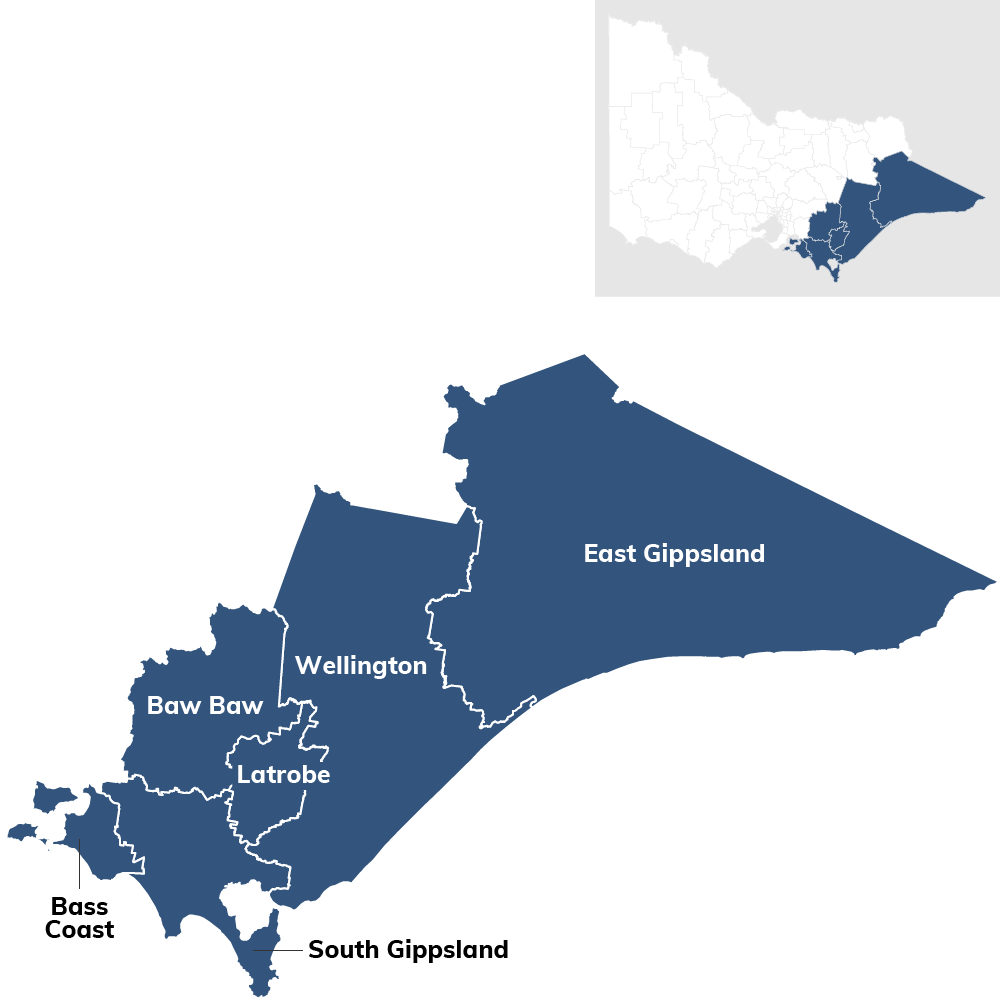
Gippsland statistics
- Gippsland is home to 313,600 Victorians.
- in terms of gross regional product, Gippsland contributes $22.2 billion to the Victorian economy each year.
- there are 143,173 workers employed across Gippsland.
Major regional industries
Gippsland is rich in natural resources and has been Victoria’s largest producer of energy for more than 100 years, with the region still generating most of the state’s electricity.
The region is heavily involved in Victoria’s energy transition, with significant investments already taking place into the establishment of offshore and onshore wind farms, and the creation of new solar and battery assets to support the electricity grid.
Gippsland’s extensive transmission and connection infrastructure is a strategic asset in Australia’s energy transition, positioning the region as a national leader in renewable energy development.
There are two proposed Renewable Energy Zones — one in central Gippsland and a second, the Gippsland Shore Line Renewable Energy Zone — which will support the establishment of the offshore wind sector.
The agribusiness sector is a major employer in the region, utilising Gippsland’s mixture of strong transport connections, water, fertile soil and favourable climate.
The region is also home to a proud and established manufacturing base, with major suppliers including:
- Patties Pies
- One Harvest
- Bega Dairy
- Maffra Cheese
- Saputo Dairy
- Burra Foods
- Pure Harvest
- Flavorite.
Health care and education are two of the region’s strongest growth sectors, as communities and organisations work to meet the demands of a growing population. We are supporting this work through the provision of accommodation for key workers across the region, ensuring that workers are available where they are most needed.
Gippsland is also home to a thriving visitor economy that leverages the region’s beautiful natural assets to delight visitors – be they local, interstate or international.
Regional strengths and opportunities
Gippsland is leading the state’s renewable energy transition and is home to Australia’s largest declared offshore wind zone, extending from Lakes Entrance to Wilsons Promontory.
There are several significant geothermal aquifers across the region, which have great potential to provide sustainable heat energy for food manufacturing and protected cropping, while helping to drive down operational costs.
The region’s thriving food and fibre sector contributes $2 billion gross value added to the Victorian economy and supports more than 14,000 jobs. It is currently the focus of a government-led consortium to drive more innovation, production and collaboration across the sector.
Further growth opportunities are supported by highly productive agricultural land and extensive coastlines, which are ideally placed to support intensive farming, organic food production and aquaculture activities.
Gippsland’s tourism assets, including the Phillip Island Penguin Parade, the magnificent Gippsland Lakes and Wilsons Promontory, are world famous and form the backbone of a dynamic visitor economy, which continues to move from strength to strength.
Recent investment is also enhancing Gippsland's potential as a leader in dairy innovation – adding to the region’s successful, competitive and sustainable dairy industry. We've also supported the Gippsland Dairy Industry Strategy, which identifies priorities and strategic objectives for the next 10 years.
The region also hosts a growing aviation, defence and advanced manufacturing sector.
Industrial precincts
Gippsland’s industrial precincts provide investors with strategic connectivity, ready-to-develop sites, and the opportunity to participate in the region’s long-term economic growth.
The region also presents significant advantages to industry and business through its direct connection to the M1 Growth Corridor – a vital economic region stretching from the Latrobe Valley to Geelong. Via the M1, Gippsland is connected to Australia’s largest manufacturing hub in the southeast of Melbourne.
This freight corridor unites renewable energy sectors and highly valued agriculture products with manufacturing and processing centres, creating a synergistic relationship that maximises economic and social benefits.
Gippsland Logistics and Manufacturing Precinct (GLaMP)
GLaMP is a 69ha, fully serviced intermodal logistics and manufacturing precinct that’s located beside the Princes Freeway in the Latrobe Valley.
Providing excellent connectivity, GLaMP is well placed to support the continued growth of Gippsland’s $7 billion food and fibre, advanced manufacturing and defence sectors. It is strategically positioned to support Victoria’s renewable energy transition and burgeoning circular economy sector.
Bairnsdale South Industrial Estate
The Bairnsdale South Industrial Estate is enhancing regional Victoria’s appeal as a prime location for industrial growth, thanks to the completion of critical water system upgrades that will support business investment and job growth.
Learn more about RDV's investment in Bairnsdale South Industrial Estate.
Liveability
Gippsland is home to regional Victoria’s largest education institution Federation University, which offers a broad range of higher education and research opportunities.
TAFE Gippsland also offers a wide range of vocational education and training (VET) courses across its 13 campuses in the region, which can be found across 9 locations between Morwell and Lakes Entrance.
The region is also home to the Gippsland High-Tech Precinct, which includes institutions such as the Morwell Innovation Hub. This hub, which was created thanks to Victorian Government investment and support, brings together teams from the public, private and university sectors to drive innovation across a broad range of industries. This also provides unique career development and upskilling opportunities for workers, right in their own backyard.
The region’s dynamic geography and thriving sports and cultural scenes help to support strong health and wellbeing outcomes for residents, who have no shortage of festivals, competitions and unforgettable destinations at their fingertips.
A growing and innovative region with a skilled workforce, Gippsland has many opportunities for potential investors.
Municipalities
Gippsland is home to:
Regional Economic Development Strategy
Gippsland’s Regional Economy Development Strategy (REDS) can be found Victoria's Regional Economic Development Strategies (REDS) identify strategic directions to further drive growth and prosperity in regional Victoria. Learn more about Gippsland's REDS.