
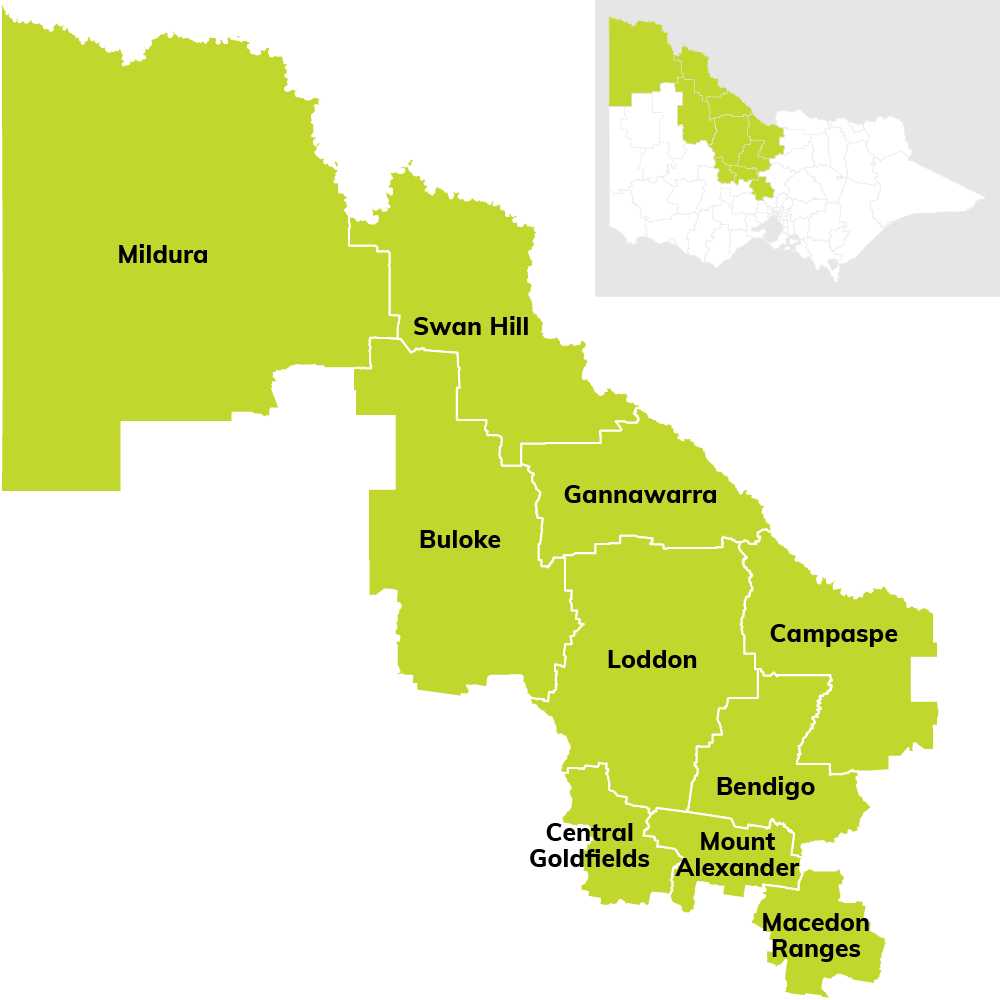
The Loddon Mallee region covers more than a quarter of Victoria, stretching from Melbourne’s peri-urban fringe to Mildura in the northwest. One of the most consistently warm climates in the state, the region is home to a thriving economy and diverse natural, resource-rich environment.
Loddon Mallee’s prominent industries include:
- agribusiness
- advanced manufacturing
- building and construction
- mining
- renewable energy
- tourism
- financial services.
As a major food producing region, Loddon Mallee has vibrant manufacturing and service sectors that take produce from paddock to plate, and the region is acclaimed for its produce, restaurants and wineries – with the latter drawing visitors from far and wide to experience the best the region has to offer.
Loddon Mallee statistics
- Loddon Mallee is home to 355,900 Victorians
- in terms of gross regional product, the region contributes $22.1 billion to the Victorian economy each year.
- there are more than 172,947.
Major regional industries
Loddon Mallee has one of the most diverse agriculture economies in Australia, with access to large scale irrigation and ample land – as well as established industries in horticulture, protected cropping, grains and intensive industries.
The region leads the way in Australia's exports for almonds – producing more than half of the country’s almond crop – and table grapes, wine and citrus, as well as Victoria’s production of tomatoes, poultry, oil seeds and hay. It is also home to the southern hemisphere’s largest olive producer, Cobram Estate, and responsible for more than half of Australia’s olive oil production.
As a result, the Loddon Mallee region is a significant hub for food product manufacturing, with the sector producing $863 million gross value added.
Key food processing activities include meat, dairy, fruit, and vegetables, with major processing locations in Bendigo, Echuca, and Castlemaine. The region is also notable for the significant number of businesses that support its production and processing of poultry and eggs.
The Mining and Engineering Technology Services industry is strong, with the region having Australia's only antimony mines at Costerfield, and Victoria's largest gold producing mine at Fosterville. The Murray Basin, which stretches through the Loddon Mallee region and into New South Wales and South Australia is also the world’s largest deposit of critical minerals sands, with Victoria possessing the largest share of identified zircon and rutile resources.
Financial and insurance services are the second largest gross value add industry in the Loddon Campaspe sub-region, which is home to Bendigo Bank - the only Australian bank headquartered in a regional area.
Advanced manufacturing is also a thriving industry in Loddon Campaspe, with the region established as the manufacturing home for the Bushmaster defence vehicle at the Thales Group’s Bendigo factory.
Regional strengths and opportunities
The agricultural industry plays a crucial role in the broader supply chain and freight and logistics sector, making Loddon Mallee a vital contributor to Victoria's food industry. Cropping and dry land farming continue to be major economic drivers for the region, and opportunities exist to leverage the region’s strength in horticulture as one of Australia's leading exporters.
Employment is growing in the services sectors, particularly in health and education, as well as related industries, such as IT and professional and business services.
The Loddon Campaspe sub-region in particular benefits from well-established road and rail links with Melbourne, which are creating an employment and innovation corridor.
The region’s cross-border zones have untapped economic potential as critical transport and socioeconomic hubs that can be linked through tri-state connections with New South Wales and South Australia.
The cross-border area in the Mallee subregion is also an agricultural hotspot, reporting an annual horticultural output of more than $1.7 billion.
Northwest Victoria holds globally significant critical mineral resources with potential for exploration and mining.
The region has also been identified as a potential location for a northwest renewable energy zone, which would make use of the region’s idyllic weather to produce green energy for the state.
There are growing opportunities in the visitor economy sector, with Loddon Mallee home to a wide range of natural, cultural and built attractions, including:
- First Nations heritage sites
- the Murray River
- Ramsar wetlands
- Hanging Rock.
Further opportunities to enhance the visitor economy have also been created by:
- Bendigo’s recognition as a City of Gastronomy by the UNESCO Creative Cities Network
- Victorian Goldfields’ addition to Australia’s World Heritage Tentative list
- the creation of Mildura’s Trail of Lights
- ongoing major redevelopment of the Bendigo Art Gallery – one of the oldest and largest in regional Australia.
Industrial precincts
Regional Development Victoria will be delivering the Trunk Infrastructure Fund in support of the Economic Growth Statement. To learn more about this upcoming program, visit the Trunk Infrastructure Fund.
Loddon Mallee’s industrial precincts are unlocking new opportunities for investors through enhanced freight and logistics capacity, improved connectivity, and a pipeline of industrial land that will drive future regional growth and jobs.
Bendigo Airport
Bendigo Airport provides the largest capacity of domestic passenger flights in north-Central Victoria, with City of Greater Bendigo’s strategic plan outlining an expectation of the airport moving 20,000 passengers annually by 2034 and establishing new routes – including to Launceston and Adelaide.
We recently contributed $3.5 million to help upgrade existing roads and infrastructure, expanding the new terminal and delivering the Bendigo Airport Business Park.
Bendigo Regional Employment Precinct (BREP)
Bendigo Regional Employment Precinct will unlock a 294ha multi-staged industrial precinct to address shortage of industrial land in Bendigo. Water infrastructure upgrades have commenced and are expected to be complete in 2026. Target industries include transport, manufacturing, mining supply and food processing.
Mildura Airport
Mildura Airport is the largest regional airport in Victoria with the capacity to transport up to 400,000 passengers per year. The airport provides critical services and connections for the Mallee subregion and is a significant driver of economic growth. It supports the regional workforce's access to cross–border worksites – including mines and energy projects.
Liveability
The region offers a broad range of educational facilities, including:
- pre-schools, primary schools and secondary schools
- various TAFE campuses
- La Trobe University campuses in Bendigo and Mildura
- Swan Hill International College
- the Regional University Hub – also in Swan Hill.
These and other institutions continue to support a locally trained and skilled workforce that’s helping to drive economic growth across the region.
Loddon Mallee is also a key hub for sport and recreation activities, supporting the sector to thrive while offering development opportunities for athletes and supporting health and well-being outcomes for communities.
Our investments in worker housing across the region is supporting business growth and providing more options for workers and their families looking to make a home for themselves in the northwestern part of the state.
Unique tourism attractions, like the Mallee Silo Art Trail, the Port of Echuca Discovery Centre, Golden Dragon Museum and Bendigo’s Great Stupa of Universal Compassion are also helping to drive growth across the visitor economy, presenting ongoing opportunities for current and future tourism providers.
Theatres and arts centres are open through the year, supporting the creative economy and community-based theatre companies, upholding a strong regional tradition. The iconic Bendigo Art Gallery has generated more than $113 million for the region since 2012 and is undergoing a renovation to expand and further develop the building as a crucial cultural and tourism destination.
Loddon Mallee is also home to an impressive range of festivals, exhibitions and significant events, including those held at the famous Hanging Rock and Bendigo’s annual Easter festival featuring Sun Loong – the longest parade dragon in the world.
From thriving industries to a diverse and skilled workforce, and unique landscapes that support tourism and recreation activities, Loddon Mallee offers an impressive array of opportunities for investment.
Municipalities
Loddon Mallee is home to:
- Buloke Shire
- Campaspe Shire
- Central Goldfields Shire
- City of Greater Bendigo
- Gannawarra Shire
- Loddon Shire
- Macedon Ranges Shire
- Mildura Rural City
- Mount Alexander Shire
- Swan Hill Rural City
Regional Economic Development Strategy
Victoria's Regional Economic Development Strategies (REDS) identify strategic directions to further drive growth and prosperity in regional Victoria. Providing a consistent, evidence-based framework for understanding Victoria’s regional economies, the REDS can help public and private entities achieve stronger outcomes for their region.
Learn more about the Regional Economic Development Strategies.