
The Grampians region stretches 50,000 km² from the western edge of Melbourne to the South Australian border.
The region is home to traditional industries such as agriculture and manufacturing, a thriving visitor economy and growing advanced manufacturing and clean economy sectors.
The Grampians region helps the state meet its power needs and produces food, fibre and materials that service communities and critical industries – throughout Australia and around the world.
Key investment opportunities are largely centered in advanced manufacturing, the clean economy, food and fibre processing, and the visitor economy.
These are supported by strong road and rail connections along the Melbourne to Adelaide freight corridor, as well as improved air connections that run out of the expanded Ballarat Airport.
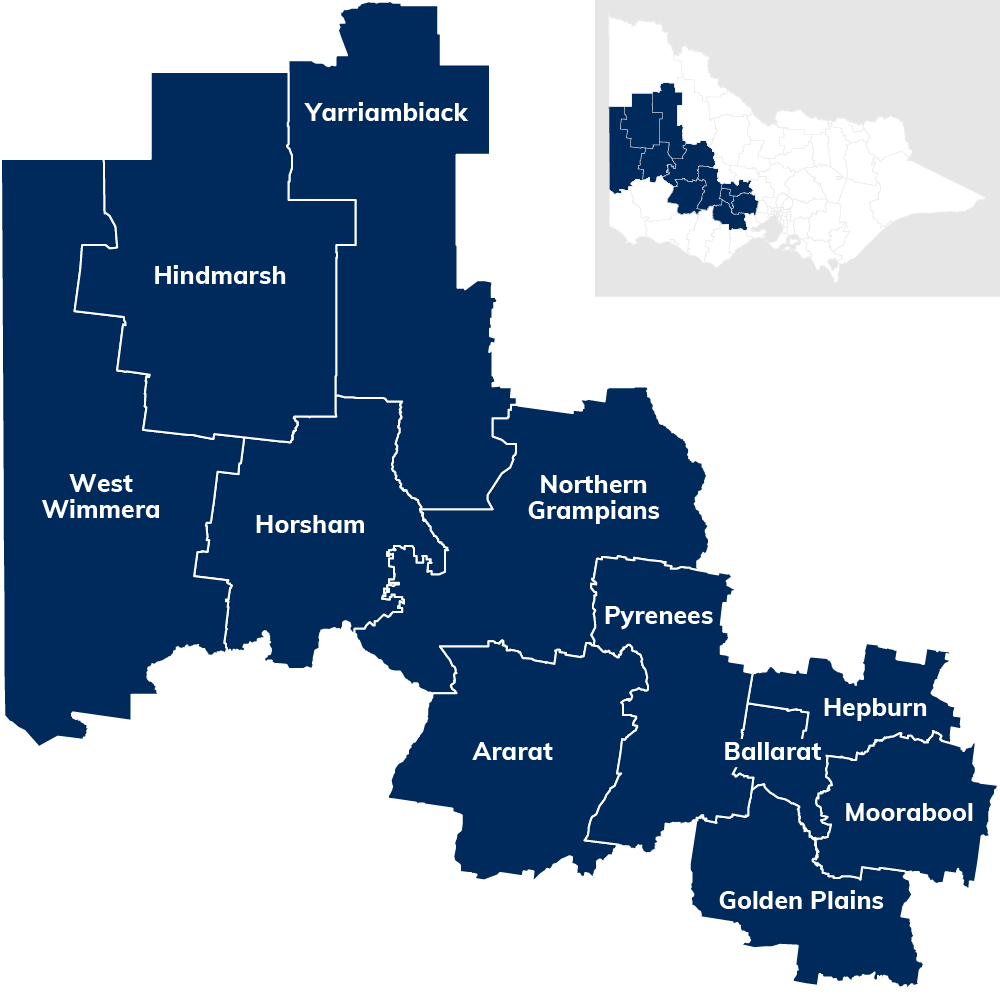
Grampians statistics
- Grampians is home to more than 274,000 Victorians.
- in terms of gross regional product, the region contributes over $17.4 billion to the Victorian economy each year.
- there are more than 136,838 workers employed across Grampians.
Major regional industries
Grampians’ varied geography supports different economic characteristics across the region, from the mineral resources and dry land farming areas in the Wimmera to the Ballarat-driven economy of the Central Highlands.
In the Wimmera Southern Mallee, there is a focus on diversifying the regional economic base by producing a wider range of food and fibre products, capitalising on energy generation opportunities and expanding the mining of critical minerals.
In the Central Highlands sub-region, Ballarat is growing its service industries to keep pace with population growth, including:
- health care and social assistance
- education and training
- professional services
- Information and Communications Technology (ICT) services.
The Grampians region also has a significant manufacturing base that includes companies such as:
- Alevo
- Alstom
- AME Systems
- CE Bartlett Manufacturing
- Ferndale Foods
- Hakubaku
- Haymes Paints
- Mars Confectionary
- Masterfoods
- MaxiTRANS.
Regional strengths and opportunities
The Grampians’ diverse and growing agribusiness sector is well-placed to meet the increased demand for high quality food products across Asian markets, which also promises to bolster the regional supply chain and industries including freight and logistics.
Completion of the Wimmera Mallee Pipeline will provide the necessary water access to realise opportunities for intensive animal industries like dairy production, as well as expansion of horticultural and agricultural industries.
New opportunities are also emerging in renewable energy, with the region’s abundance of sunshine and wind ideal to support green energy projects. This has resulted in a proposal for the Grampians to host 3 of Victoria’s 7 planned Renewable Energy Zones (REZ), which would host wind, solar and battery infrastructure.
Victorian Government investment in regional tourism attraction and iconic destinations like the Grampians National Park (Gariwerd) is helping to drive more visitation to the region, presenting greater opportunities for hospitality and tourism providers.
New opportunities are also emerging in advanced manufacturing and mineral sands mining, further cementing the region’s important place in the regional supply chain. This is supported by strong road, rail and air connections to Melbourne, the Port of Melbourne, the Port of Portland and Adelaide.
Industrial precincts
Regional Development Victoria will be delivering the Trunk Infrastructure Fund in support of the Economic Growth Statement. To learn more about this upcoming program, visit the Trunk Infrastructure Fund.
Industrial precincts in the Grampians provide investors with strategic access to transport networks, specialised opportunities in agriculture production and processing, and land supply that will fuel the region’s economic growth and resilience into the future.
Ballarat West Employment Zone (BWEZ)
The Ballarat West Employment Zone (BWEZ) targets food processing, transport, and manufacturing. BWEZ is a joint initiative between the Victorian Government and the City of Ballarat to develop a 438ha industrial precinct and intermodal freight hub.
BWEZ is being delivered in 5 commercial stages, plus the Intermodal Freight Hub and a residential area. Several businesses are already established at BWEZ, including CHS Broadbent, George Weston Foods, and Alevo/Athelegen.
Parwan, Bacchus Marsh
Parwan targets agriculture production and processing, and transport. The 2,880ha precinct is expected to create 1,500 direct jobs. The Precinct City Gate Gas connection was completed in May 2022, servicing the site with natural gas and helping to attract L&G Meats to establish operations at the site.
The Victorian Planning Authority is currently undertaking detailed planning work aimed to support further creation of industrial land within the precinct.
Wimmera Logistics Hub
The Wimmera Logistics Hub is a major intermodal freight, logistics and agricultural hub located in Dooen, 15km north of Horsham. It includes 80ha of serviced industrial land with direct connectivity by rail and road to port.
Liveability
The region is home to several higher education institutions, including:
- Federation University
- the Australian Catholic University
- NMIT College of Wine
- various TAFE colleges.
These support the training of a strong regional workforce and ensure that people of all ages can undertake their educational journey close to home.
The Grampians region also possesses strong sporting, leisure and cultural infrastructure, which supports a wide range of businesses, organisations and community groups. These include Ballarat’s Eureka Stadium and the Major Events Precinct, the Djuwang Baring mountain bike trails in Creswick, and the 160 km-long Grampians Peaks Trail. The Ballarat Showgrounds at Mount Rowan also support a strong roster of regional events, including the beloved Ballarat Show, and provide an important home for livestock events.
Her Majesty’s Theatre Ballarat is Australia’s oldest continuously used theatre space, supporting a wide range of professional and amateur productions, as well as community events like the Ballarat Eisteddfod.
Grampians is also home to Australia’s first precinct for environmental art – Wama – which is located on the foothills of the Grampians National Park (Gariwerd).
Together, these and other locations support a vibrant regional creative economy, while venues like Eureka Stadium, Selkirk Stadium and others provide sports pathways for regional athletes and wellbeing benefits for families.
With growing, diverse industries, a skilled workforce and stunning natural assets that supporting a thriving visitor economy, the Grampians region presents a wealth of opportunities for current and potential investors.
Municipalities
Grampians is home to:
- Ararat Rural City
- City of Ballarat
- Golden Plains Shire
- Hepburn Shire
- Hindmarsh Shire
- Horsham Rural City
- Moorabool Shire
- Northern Grampians Shire
- Pyrenees Shire
- West Wimmera Shire
- Yarriambiack Shire
Regional Economic Development Strategy
Victoria's Regional Economic Development Strategies (REDS) identify strategic directions to further drive growth and prosperity in regional Victoria.
Providing a consistent, evidence-based framework for understanding Victoria’s regional economies, the REDS can help public and private entities achieve stronger outcomes for their region.
Learn more about the Regional Economic Development Strategies.