
Situated in north-east Victoria, Hume is a fast-growing region with a rich social and cultural history that matches the region’s natural beauty. Renowned for its world-class wines and gourmet food, the region is woven together by the Goulburn, Broken, Ovens, King and Kiewa Rivers – all vital to sustaining its thriving environment, lifestyle and economy.
Bringing together the Ovens Murray and Goulburn regions, Hume is home to vast areas of Victoria's High Country, including the Alpine Resorts and is a premier destination for nature-based tourism and cycling. It’s also home to a large section of the iconic Murray River, providing areas of cultural significance and recreational opportunities for residents and visitors.
The Hume region’s agricultural sector is at the forefront of global food production, combining:
- dairy
- viticulture
- horticulture
- olives
- aquaculture.
With two of Australia’s nationally important transport routes passing through the region, and the presence of clustered production, processing and value-add manufacturing, Hume provides an exceptional competitive advantage – linking supply chains to national and international markets.
Hume’s strong economy is underpinned by a range of traditional and new industries, which help ensure jobs for a growing population – one that is projected to increase by almost 30% by 2036.
Hume statistics
- Hume is home to 324,200 Victorians
- in terms of gross regional product, the region contributes more than $19.9 billion to the Victorian economy each year
- there are more than 159,019 workers employed across Hume.
Major regional industries
The Hume region boasts a diverse range of industries and a skilled workforce, with agriculture concentrated in the western and alpine areas, while the eastern region is renowned for its wine production and gourmet food.
The Goulburn Valley area is a well-established agricultural region, supported by a world-leading modernised gravity-fed irrigation system.
Traditional broad acre farming is accompanied by the rise of intensive agriculture, including the growing of glasshouse produce and barn-style dairy production. These developments, combined with a diverse range of food and fibre products, endorse the ‘food bowl’ label of the Goulburn Valley and make the region a major exporter of Victorian produce and value-added food products.
Tourism is also a significant employer, driven by the region’s natural assets and key industries. The Ovens Murray sub-region alone attracts over 5 million visitors annually, with strong growth in nature-based, cycling, snow and food tourism.
Two of Australia’s nationally important transport routes – the Hume and Goulburn Valley road and rail corridors – traverse the region, providing businesses and industries with a link to major national and international supply chains through Melbourne, Sydney, Brisbane and Canberra.
This advantage has been seized upon by many advanced manufacturing, food processing and logistics and supply chain businesses including Nestle, Mars Petcare and the Woolworths Distribution Centre.
With various large and international companies already calling the region home, Hume is well placed to help investors establish or expand their regional operations.
Regional strengths and opportunities
An increase in demand for high-quality food products in key export markets in Asia and the Middle East, including fruit and dairy, presents an opportunity for Hume’s agriculture and food manufacturers, while also promising to bolster supply chain industries across the region.
Hume’s infrastructure makes it well-placed to benefit from this expansion in freight activity, with major transport and logistics businesses centred around key precincts such as Logic in Wodonga and GV Link in Shepparton.
Hume's natural assets also provide endless opportunities for adventure tourism experiences, including snow sports, mountain biking, boating and hiking. Lake Eildon’s houseboat industry also presents a unique tourism, recreational and industry offering.
These experiences, combined with thriving food and beverage destinations such as the King Valley’s Prosecco Road, have the potential to grow the region’s share of international tourism.
Industrial precincts
Regional Development Victoria will be delivering the Trunk Infrastructure Fund in support of the Economic Growth Statement. To learn more about this upcoming program, visit the Trunk Infrastructure Fund.
Logic Industrial Precinct
The Logic Industrial Precinct sits along one of Australia’s most important freight corridors, making it a prime location for manufacturing, logistics, transport and training businesses. With excellent road and rail access, tenants can reach more than 75% of Australia’s population with next day transport.
Logic also provides strong opportunities for advanced manufacturing, agri-business, food processing, renewable energy and warehousing operations, supported by excellent connectivity and a skilled regional workforce.
The next development phase will further install core infrastructure and services for the precinct’s extension.
Logic currently supports around 800 jobs across a range of businesses.
Liveability
Hume is diverse and dynamic. It’s home to a rich multicultural heritage and the largest population of First Nations people in regional Victoria. Hume’s contrasting landscapes stretch from the rolling hills of the Upper Murray all the way down to the peri-urban areas around Wallan, and from the snowfields and high country to the productive Goulburn Murray Irrigation District.
Home to TAFE institutions, La Trobe University, the University of Melbourne and Charles Sturt University (co-located with GOTAFE in Wangaratta), Hume residents have higher education opportunities on their doorstep. There are many kindergartens, pre-schools, primary schools and secondary schools with both public and private options available.
Recreation reserves hosting football, soccer, netball, hockey and tennis matches are prominent throughout the region, as are golf courses. The high country is a haven for snow sports, and Lake Hume, Lake Buffalo and Lake Eildon are popular for water sports. The region is also home Australia’s largest regional tennis complex at Wodonga, as well as hundreds of kilometres of sealed trails, mountain bike tracks, gravel roads and alpine climbs that pass through spectacular scenery.
Several festivals are held in the Hume region each year, offering something for everyone. The Bright Autumn Festival, Rutherglen Winery Walk About and the SheppARTon Festival are just a few to add to your calendar.
With strong freight connections, thriving industries and natural assets that support a broad range of tourism and recreation providers, Hume is rich with opportunities for investment.
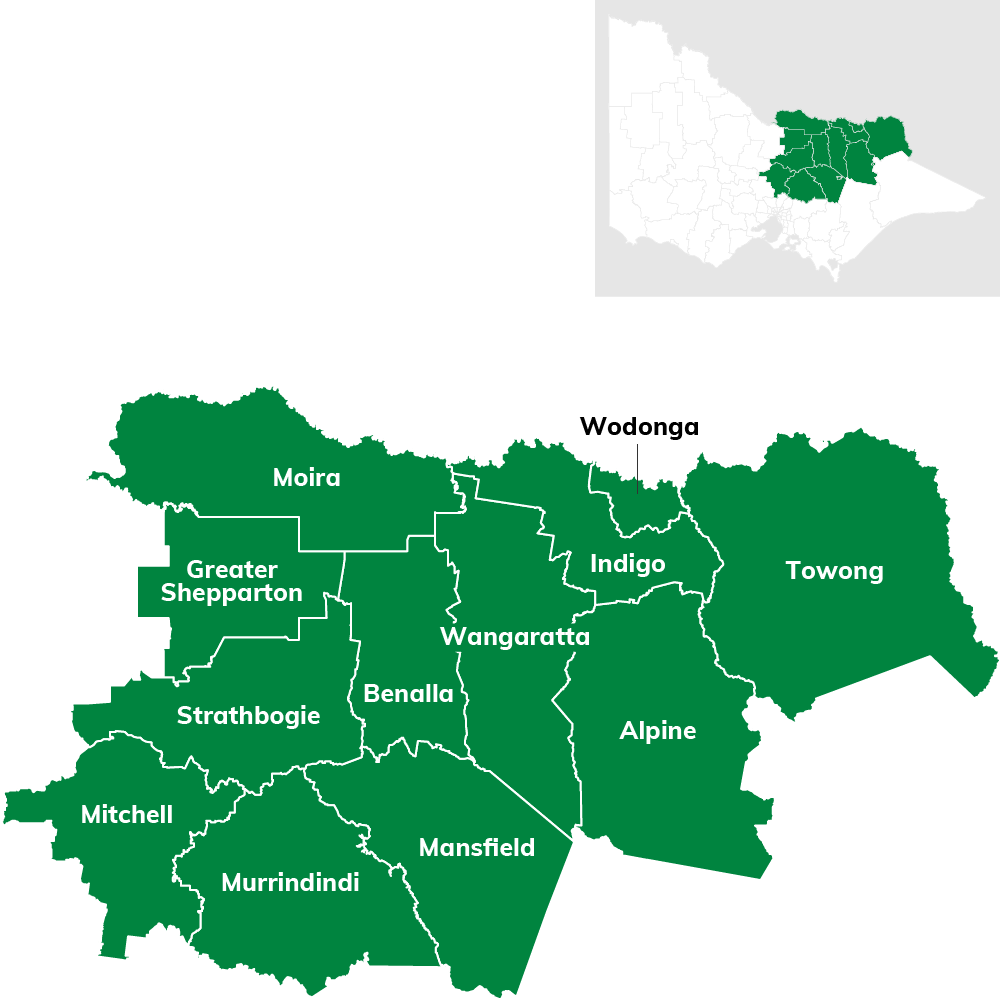
Municipalities
Hume is home to:
- Alpine Shire
- Benalla Rural City
- City of Wodonga
- Greater Shepparton City
- Indigo Shire
- Mansfield Shire
- Mitchell Shire
- Moira Shire
- Murrindindi Shire
- Strathbogie Shire
- Towong Shire
- Wangaratta Rural City
Regional Economic Development Strategy
Victoria's Regional Economic Development Strategies (REDS) identify strategic directions to further drive growth and prosperity in regional Victoria.
Providing a consistent, evidence-based framework for understanding Victoria’s regional economies, the REDS can help public and private entities achieve stronger outcomes for their region.
Learn more about the Regional Economic Development Strategies.